RTP is the most-cited number in Plinko and one of the most-misunderstood. Players see “99 percent RTP” and read it as “I will keep 99 percent of my deposit.” Players see “97 percent RTP” and read it as “I have a 97 percent chance of winning each spin.” Both interpretations are wrong, and both produce predictable misjudgments about Plinko sessions. This page is the careful explanation: what RTP actually is, what it implies for your real sessions, and how to verify that a casino’s published RTP is the rate you are actually getting.
The mathematical content of this page is not difficult. If you got through high-school probability, you have the tools. The reason RTP is so often misread is that it is presented as a percent and people read percents as proportions of the immediate session rather than long-run averages over much larger samples. Fix that misreading and most other Plinko misunderstandings dissolve.
What RTP actually means
RTP — Return to Player — is the percentage of total money wagered on a game that is returned to players as winnings, averaged over the long run. A 99 percent RTP Plinko returns, on average across very large samples, 99 cents in winnings for every dollar wagered. The other 1 cent stays with the house. That 1 percent is the house edge.
The phrase “averaged over the long run” is doing all the work in that definition. In a specific 100-drop session, the realized return — total winnings divided by total wagered — can deviate dramatically from the published RTP. Realized returns of 60 percent and 180 percent across a 100-drop session are not unusual on High-risk Plinko. The 99 percent target is the limit toward which realized returns converge as the sample size grows, not a guarantee about any specific session.
To make this concrete: imagine a $1 bet on a 99 percent RTP Plinko. The expected value of that single bet is $0.99 — meaning, if you ran that same bet under identical conditions a billion times and averaged the results, the average payout per bet would converge to $0.99. The 1 cent gap is the house edge per bet. In any single bet, the actual outcome will be one of the multiplier slots: maybe 0.2x ($0.20), maybe 5x ($5), maybe 1000x ($1,000) on the very rare edge slot. The 99-cent figure is invisible in any single outcome; it emerges as an average across many.
RTP vs house edge
These are the same number reflected across 100 percent. A 99 percent RTP equals a 1 percent house edge. A 97 percent RTP equals a 3 percent house edge. A 96 percent RTP equals a 4 percent house edge.
The house edge is the casino’s mathematical expectation per dollar wagered. The casino does not “win” 1 cent on every drop; it loses or gains a variable amount, depending on which slot the chip lands in. But across millions of drops, the casino’s net result converges to (house edge × total volume wagered). This is how casinos build their business model on negative-expectation games — variance is large per bet, deterministic at scale.
A practical implication: small differences in RTP produce large differences in long-run expected loss. A player who wagers $10,000 over a year at 99 percent RTP expects to lose $100. The same player at 97 percent RTP expects to lose $300. Three-fold difference in expected loss for a two-percentage-point difference in RTP. This is why provider choice matters more than risk-mode or row-count choice.
RTPs of the major Plinko games
The figures below are as published by the providers at time of writing. Per-casino integrations occasionally show RTP variations (some casinos run lower-RTP versions of the same game); the casino-specific value is shown in the game’s info modal and should be the authoritative number for any specific session.
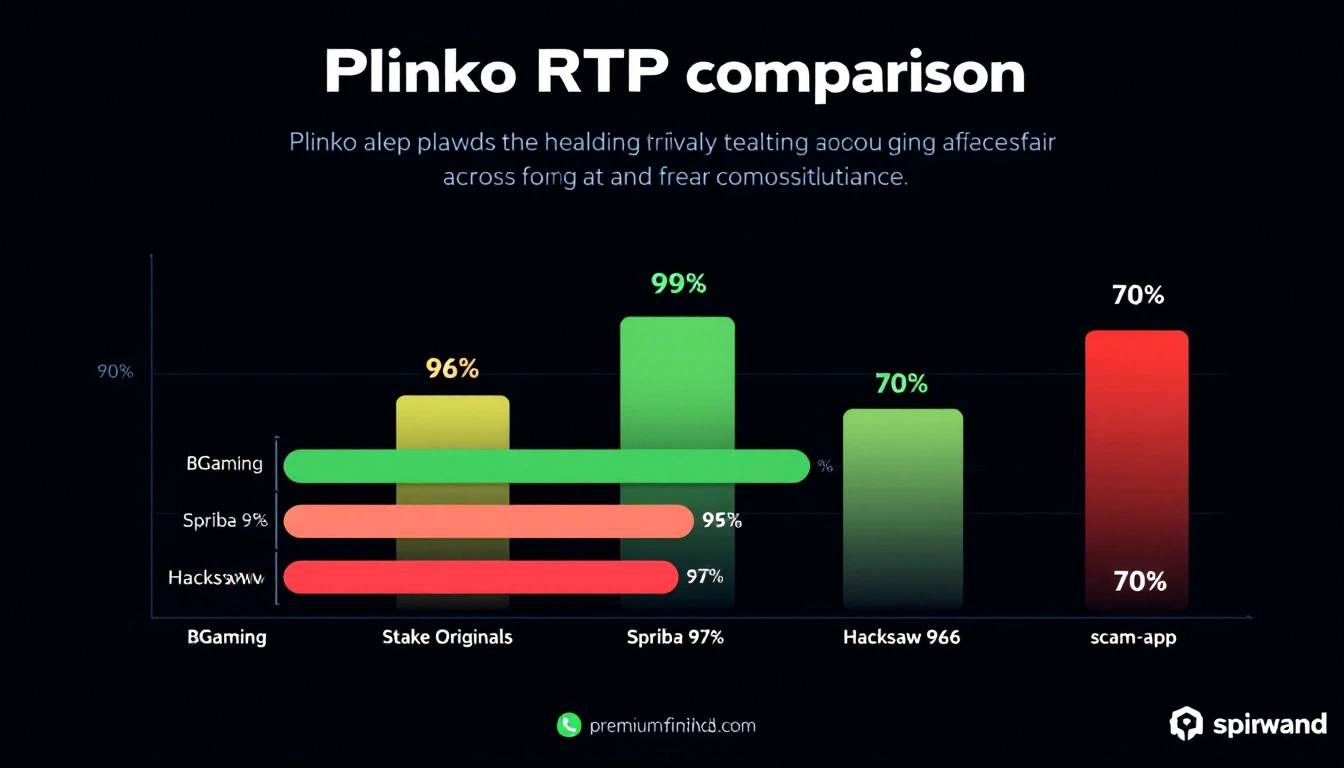
BGaming Plinko: 99 percent RTP. Constant across all configurations (Low/Medium/High risk × 8-16 rows). The de-facto benchmark for online Plinko RTP.
Stake Originals Plinko: 99 percent RTP. Constant across configurations. Tied with BGaming for the highest published RTP among widely-available Plinko games.
Spribe Plinko: 97 percent RTP. Constant across configurations. Lower RTP, higher polish — a deliberate trade-off Spribe is open about.
Smartsoft Plinko X: ~97 percent RTP. The hybrid mechanics (bonus rounds, persistent multipliers) make the RTP calculation more complex than vanilla Plinko, but the headline figure is around 97 percent.
Hacksaw Gaming Plinko: 97 percent RTP typical across the studio’s Plinko entries. High volatility, slot-style multiplier tables.
Evoplay Plinko: 96-98 percent RTP depending on the specific variant. The Evoplay catalog is broader than most providers’ Plinko entries; check the in-game info modal for the specific version.
Turbo Games and other smaller providers: 95-98 percent RTP typically. We recommend checking the published RTP per game before play and avoiding any unlabeled Plinko games (the absence of published RTP is itself information).
Two casinos running the same provider’s game can technically advertise different RTPs if the provider offers RTP tiers (some studios do, some don’t). The number that matters is the one the specific casino displays in the game’s info modal at the moment you are about to play.
How to verify RTP claims
Verifying that a published RTP is actually being delivered requires more than reading the marketing. The practical verification path depends on whether the game is provably fair.
At provably fair Plinko
A provably fair Plinko publishes the multiplier table and the algorithm by which the server seed, client seed, and nonce produce the chip’s path. You can:
- Reconstruct the slot probabilities. The Galton board geometry gives slot probability = C(n, k) / 2^n, where n is the number of rows and k is the number of right-deflections. This is the binomial distribution. The probabilities sum to 1.
- Read the published multiplier table for the configuration you are playing.
- Compute RTP = Σ (probability × multiplier) across all slots. If the result matches the published RTP, the math is consistent.
- Verify individual drops by replaying the seed reveal after the server seed rotates. Each drop’s left/right deflection sequence is determined by the HMAC-SHA256 output. If your replay reproduces the casino’s outcomes exactly, the randomness was not manipulated.
The first three steps verify the multiplier table is correctly designed for the published RTP. The fourth step verifies the casino did not manipulate individual outcomes. Together they are a cryptographically strong proof.
The Provably Fair Plinko pillar walks through the verification step-by-step with code snippets.
At non-provably-fair Plinko
If a game does not publish the seed-based verification path, you are relying on the casino’s regulator and audit firm. Major casino-game RNG audits are performed by iTech Labs, eCOGRA, BMM Testlabs, GLI, and a handful of others. An audited game has a certificate, usually displayed in the game info modal or on the provider’s site, listing the audit firm, the audit date, and the certified RTP. This is meaningfully better than nothing, but you cannot personally verify any specific drop.
For non-provably-fair Plinko, the practical verification approach is statistical and longitudinal. Over a large sample of bets, the realized RTP should converge to the published figure. If your records show consistent under-performance across thousands of drops, that is evidence — though not proof — of a problem.
RTP variance over short sessions
A common confusion: players play 50 drops, calculate that their realized return was 65 percent, and conclude the casino is rigged. This conclusion is almost never warranted.
Plinko’s variance is high. Across 50 drops on Medium risk, realized returns can range from below 40 percent to above 150 percent without any irregularity. The standard deviation of realized RTP across a 50-drop sample is large — much larger than the 1-3 percent house edge most players have in mind. To get a confidence interval around the realized RTP that is comparable to the house edge requires very large samples.
A rough rule of thumb: meaningful RTP estimation from your own records starts to become possible around 1,000-2,000 drops on Low risk, and 5,000-10,000 drops on High risk. Below those thresholds, your realized return is dominated by variance, not by the casino’s actual RTP delivery.
The Strategy pillar covers the practical implications of variance-vs-EV.
Advertised vs realized RTP
The advertised RTP is the theoretical long-run figure derived from the multiplier table. The realized RTP is the actual percentage paid back to players over a given period. Under normal operation at a legitimate casino, these should match within statistical noise across large enough samples.
Several mechanisms can cause divergence even at legitimate operators:
Software bugs. Rare but documented. A miscoded multiplier table will produce a realized RTP that differs from the published one. These bugs tend to be discovered quickly by the provably-fair-verification community when they happen.
RTP tier switching. Some providers ship multiple RTP versions of the same game, and casinos choose which to deploy. A casino displaying 99 percent in marketing but deploying the 96 percent variant is misleading — this is a documented practice at some lower-tier operators. Always check the in-game info modal.
Promotional adjustments. Some casinos run promotions that effectively boost RTP for a session (e.g., free-spin equivalents, cashback). Realized RTP including the promotion can exceed 100 percent for the session; this is intentional marketing, not a casino mistake.
For most players, the practical takeaway is: stick to operators with published per-game RTP that matches the provider’s documentation, verify provably fair drops when the option is offered, and assume that any large divergence between your realized and the published RTP is either variance (most likely, especially below 5,000 drops) or RTP tier deception (possible at lower-tier operators).
Practical implications of RTP for your play
Three concrete things to do with this knowledge.
Choose the highest-RTP game available at your casino. This is the single largest EV improvement you can make as a player. Switching from a 97 percent RTP game to a 99 percent RTP game cuts your expected loss by two-thirds per dollar wagered. Over a year of meaningful play, that is real money.
Disregard RTP as a session-level prediction. A 99 percent RTP does not mean any specific session will return 99 percent. Plan your bankroll for variance, not for the headline RTP.
Use RTP to size your bankroll for long-run play. If you intend to wager $5,000 across a year on Plinko at 99 percent RTP, your expected loss is $50 plus variance. That is your “true cost” of Plinko entertainment in expectation. If that number is acceptable, the math is sustainable. If it is not, scale down.
The math, briefly
For readers who want the math explicit, the RTP of a Plinko game with n rows and a multiplier vector M (where M[k] is the multiplier on slot k) is:
RTP = Σ (P[k] × M[k]) for k from 0 to nwhere P[k] is the probability of landing in slot k, given by the binomial distribution:
P[k] = C(n, k) / 2^n (with p = 0.5 deflection probability per peg)The binomial coefficient C(n, k) = n! / (k! × (n-k)!) counts the number of left-right deflection paths that lead to slot k. For n = 16 rows, the center slot (k = 8) has C(16, 8) = 12,870 paths, while the edge slot (k = 0 or k = 16) has C(16, 0) = 1 path. The probability ratio between center and edge is therefore 12,870:1.
The provider’s task is to design a multiplier vector M such that the probability-weighted sum equals the target RTP, and such that the variance distribution feels good to play. A “Low risk” multiplier table for 16 rows might look like (running from center outward) something like 0.5, 0.7, 1, 1.1, 1.4, 2, 4, 7, 16, etc. A “High risk” table for the same 16 rows might be 0.2, 0.3, 0.5, 1, 1.5, 2, 4, 9, 26, 130, 1000.
Both tables can produce the same 99 percent RTP, because the (probability × multiplier) sum can be balanced differently — putting more weight on center bins or more weight on edge bins. This is why risk mode does not affect RTP: the provider holds the sum constant while reshaping the distribution.
For a worked example with specific numbers and the binomial probabilities tabulated, see The Physics of Plinko.
Comparing RTP across games
A direct comparison of major Plinko games on RTP, with the caveat that all figures are published by the provider:
| Game | Provider | Published RTP | Provably Fair |
|---|---|---|---|
| BGaming Plinko | BGaming | 99% | Yes |
| Stake Originals Plinko | Stake | 99% | Yes |
| BC.Game Originals Plinko | BC.Game | 99% | Yes |
| TrustDice Plinko | TrustDice | ~99% | Yes |
| Spribe Plinko | Spribe | 97% | Partial |
| Plinko X | Smartsoft | ~97% | Audited RNG |
| Hacksaw Plinko | Hacksaw | ~97% | Audited RNG |
| Evoplay Plinko | Evoplay | 96-98% | Audited RNG |
Two patterns are visible. First, in-house Originals at major crypto casinos tend to cluster at 99 percent RTP with full provably fair verification. Second, third-party providers (Spribe, Smartsoft, Hacksaw, Evoplay) generally sit at 96-98 percent with audited but not provably-fair-verifiable RNG.
For pure RTP optimization, the in-house Originals at Stake, BC.Game, and TrustDice are the best choice. For maximum verifiability with the highest RTP, BGaming or any of those in-house Originals.
Where RTP claims break down
RTP is an honest figure when reported honestly. It can mislead in several documented ways.
Selective configuration display. Some casinos display only the headline (highest) RTP figure in marketing while deploying lower-RTP variants. The cure: always read the in-game info modal, which shows the deployed RTP for the specific instance you are playing.
Bonus play overlay. During bonus playthrough, the effective RTP from the player’s perspective is often lower because bonus terms (max-bet, game-weighting) create implicit penalties on wins. The bonus terms, not the RTP, are doing the damage.
Adjusted RTP for high-volume players. A few operators have been documented adjusting in-game RTP based on player segment (VIP tiers receiving higher RTP, suspected advantage players receiving lower). This is rare and largely confined to operators in lower-quality jurisdictions. Major regulators prohibit it.
Fake provably fair. A small number of operators have claimed provably fair certification on games that did not implement the verification correctly. Independent verification (the community has reviewed the major implementations) is the safeguard. For any new casino, the question is whether the provably fair implementation has been independently audited.
The legitimacy pillar covers the operator-level signals that should make you skeptical of RTP claims.
Bottom line
RTP is a long-run average, not a session-level prediction. It matters most as a comparison tool between games and providers; it matters least as a tool for predicting any individual session. Choose Plinko games at the highest published RTP available, verify the RTP figure in the game info modal before each session, and where possible use provably fair systems to verify individual drops.
The houses still win in the long run. Choosing a 99 percent RTP game over a 97 percent one means they win two-thirds less of your money per dollar wagered. That is not nothing.
For deeper coverage on how to verify drops, read Provably Fair Plinko. For the math behind the multiplier table, see Physics of Plinko. For how to translate RTP knowledge into actual play decisions, see Plinko Strategy.
Plinko probability distribution explorer
See exactly where balls are most likely to land on a Plinko board, and how multiplier choice changes the math.
Bars show how often a ball lands in each slot over millions of drops. Bell-curve shape is binomial — middle slots dominate because more paths lead there.