For most of the world, “Plinko” still means the same thing it has meant since January 3, 1983 — a contestant on a CBS daytime soundstage, a giant pegboard mounted vertically behind them, the audience screaming as a flat disk clatters down to either pay the rent or pay nothing. It is one of American television’s most durable game-show moments, and the through-line from that moment to the modern casino category that this site otherwise covers is a single mechanical idea pushed through forty years of cultural transformation. This page is the careful, sourced account of how Plinko began at The Price Is Right, how the game show version actually works, the legendary wins, and how the heritage relates to the casino version we cover elsewhere on the site.
A disclosure that belongs at the top: PlayPlinko has no affiliation with The Price Is Right, FremantleMedia, CBS, or any entity producing or licensing the show. We cover the show because Plinko’s casino category is unintelligible without the heritage, and because the heritage is genuinely interesting. The descriptions below are sourced to publicly-available material — the show’s Wikipedia entries, archived broadcast guides, the published memoirs of Bob Barker and various former producers, and contemporary press coverage. Where we paraphrase a specific claim, we cite the source in line.
The 1983 debut
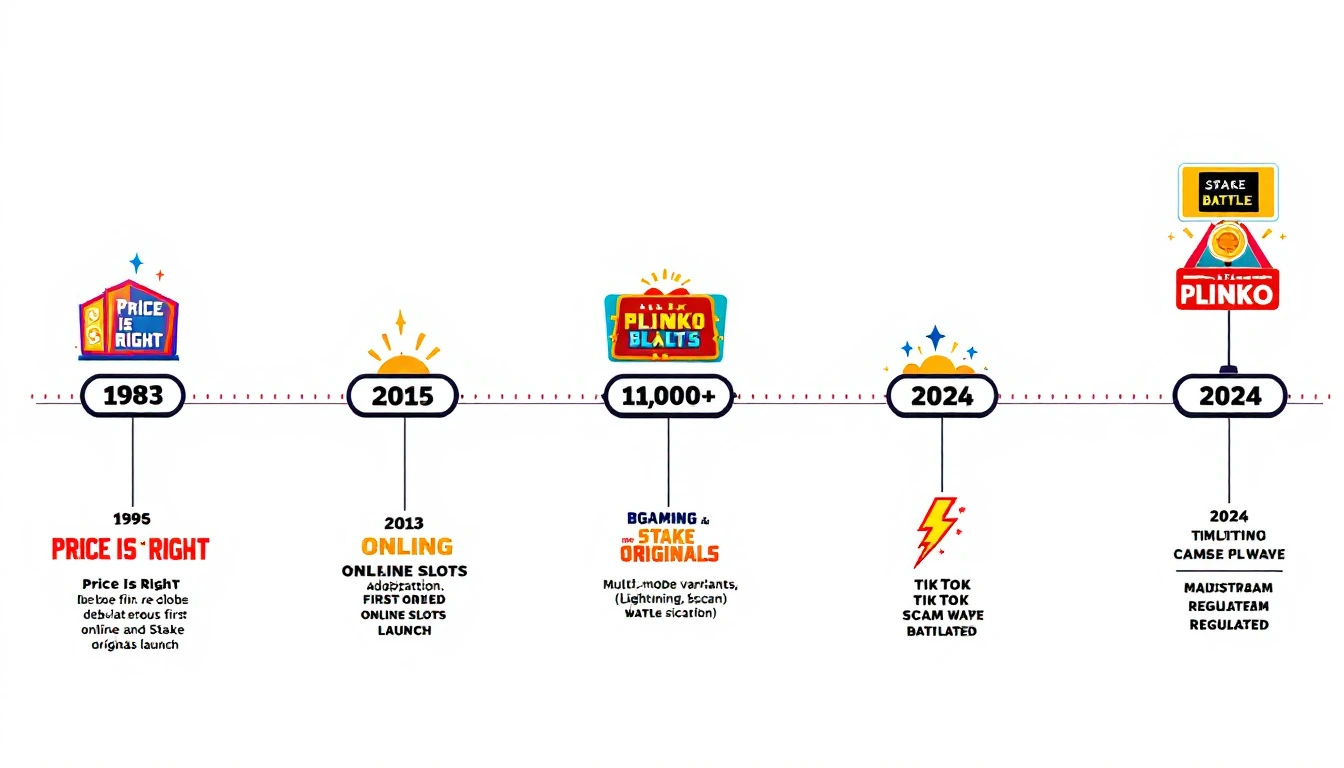
Plinko’s first airing was on the January 3, 1983 episode of The Price Is Right on CBS, hosted by Bob Barker. The show was in its eleventh year at the time. The pricing game lineup had been expanding throughout the late 1970s and early 1980s as the show’s producers, led by executive producer Frank Wayne, searched for new mechanics that would feel fresh on a daytime program that had begun to define a generation’s idea of American game-show television.
The original 1983 board had nine slots along the bottom, with values of $0, $100, $500, $1,000 (twice), and a $10,000 center slot. The maximum possible win on a single round was $25,000 — five chips, all landing in the $10,000 center slot, with the additional fifteen-thousand-dollar boost from a configuration we will get to below.
The reception was immediate and enormous. Plinko became one of the show’s signature pricing games within a few months of its debut, and by the mid-1980s the format was so identified with the show that the chip-drop physics had become a generic cultural shorthand for “random falling thing in a peg array.” That cultural cementing is what made Plinko a recognizable name to audiences who later discovered the casino category in the late 2010s.
Frank Wayne, the inventor
Plinko is credited to Frank Wayne, who served as the executive producer of The Price Is Right from the show’s 1972 debut on CBS until shortly before his death in 1988. Wayne’s career in game-show production spanned the 1950s through the 1980s, with credits including the original 1956-1965 version of The Price Is Right (a different format), and various Mark Goodson-Bill Todman productions across the period.
The specific mechanic was reportedly worked out across late 1982 in the show’s production offices. The story, as repeated in several former-staffer accounts, is that Wayne had been thinking about pricing-game mechanics that could combine the spectacle of large prizes with a clear visual representation of randomness — something a studio audience could see happening and react to in real time. The chip-and-peg-board configuration solved both: the chip’s path was visibly random for the entire fall, the audience could see the slot accumulating multiple chips, and the suspense built across each individual drop.
Wayne died in October 1988. The Plinko mechanic survived him by, at time of writing, thirty-eight years and counting — longer than most game-show segments, longer than many of the shows they originally aired on.
How the game show version works
Walking through the actual rules, because casino-Plinko players often have no idea how the original works.
A contestant called from “Contestants’ Row” wins the right to play Plinko by guessing closest to the actual retail price of a single showcased prize without going over. They are escorted to a separate stage area where the Plinko board is set up.
Before the chip-drop, the contestant plays a four-item small-prize round. Four small grocery items (typically priced under $10 each) are shown one at a time. For each item, the contestant is shown two prices and must select which one is correct. A correct guess earns the contestant a Plinko chip; an incorrect guess earns nothing.
The contestant always starts with one free Plinko chip (the “starter chip”). With the four pricing items, the contestant can earn up to four additional chips, for a maximum of five chips total. Two chips is roughly the modal outcome; five chips is uncommon but not rare.
After the pricing round, the contestant takes their accumulated chips up a small stairway to the top of the Plinko board. The board is large — about ten feet tall in the standard staging — with a pegfield occupying most of the height and the slot row across the bottom. The contestant chooses which of nine positions across the top of the board to drop each chip from, releasing each chip in turn.
Each chip falls through the peg array, deflecting left or right at each row, and lands in one of nine slots. The slot values are visible on the board: $0, $100, $500, $1,000, $0, $10,000, $0, $1,000, $500, $100, $0 (the exact configuration has varied over the years; the central $10,000 has been constant since the early years of the game).
The contestant collects the value of every chip’s landing slot. Multiple chips can land in the same slot; all are paid.
The end of the round is when the contestant has dropped all earned chips. The show goes to commercial. The contestant takes their winnings home.
The payout structure and its evolution
The slot values have changed exactly once in any meaningful way in the show’s run.
1983-2008: Slot values fixed at $0, $100, $500, $1,000, and a $10,000 center slot. The maximum possible win was capped at $25,000 by a rule limiting the number of $10,000 hits per round to a specific count, though in practice the cap rarely became binding because hitting the $10,000 slot more than once or twice was already statistically uncommon.
2008 onward: The cap was effectively removed and the payout structure adjusted so that the maximum possible win is $50,000 — five chips, each landing in the $10,000 center slot. This is the configuration the show uses in 2026.
The increase was framed at the time as both inflation adjustment (the original $10,000 slot in 1983 dollars was worth much more in purchasing power than $10,000 in 2008) and an audience-appeal upgrade. The show’s executive producers in the late 2000s — under Roger Dobkowitz initially and then Mike Richards — were generally interested in updating long-running pricing games where the payout structures had aged out of cultural plausibility, and Plinko was a natural beneficiary.
The remarkable thing is how little else has changed. The board’s physical dimensions, the chip design, the peg layout, the small-prize round structure, the on-stage choreography — all are essentially identical to 1983. Plinko is one of the most temporally stable artifacts on American daytime television.
The legendary wins
A short selection of the most-cited Plinko moments in the show’s history. The list is not exhaustive; the show has produced thousands of Plinko rounds across forty-plus years and many of them produced memorable moments.
The first $50,000 win. Following the 2008 payout adjustment, the first contestant to win the full $50,000 max — five chips all in the center slot — produced one of the most-replayed clips in the show’s modern era. The studio reaction is dramatic; Drew Carey, host at the time of the change, visibly does not believe what he is seeing. The clip has been viewed tens of millions of times on YouTube across various uploads.
Multiple max wins. Since 2008, several contestants have hit the $50,000 max. Each time it happens it becomes a notable episode within the show’s fan community, where individual broadcasts are catalogued and discussed.
The Bob Barker years’ biggest wins. Under the 1983-2008 payout structure, the maximum theoretical win was $25,000 and was achieved a handful of times. The clips from these moments — Barker’s measured reactions, the audience response, the contestants’ faces — have aged into a particular kind of warm Americana that defines the era of the show before Carey’s tenure.
The viral chip-drops. Plinko has produced a steady stream of viral moments outside of maximum-win territory: contestants who land four $0 slots in a row, contestants whose chip starts heading toward $10,000 and pinballs out to a $100 at the last peg, contestants whose entire reaction shot dominates the broadcast more than the outcome. These clips circulate independently of the show’s larger narrative arc.
The contestant reactions. A point made by former producers: Plinko’s enduring appeal is less about the money than about the contestant reactions to the money. The chip-fall is long enough — multiple seconds — that the contestant has time to process, hope, react. The slot landing is sharp and clear. The reaction is uniquely intense for game-show television, where most outcomes are revealed in a half-second buzzer or a card-reveal. Plinko’s drama is in the duration.
Why Plinko endures
Forty-plus years of any television segment is unusual. Forty-plus years of the same segment, essentially unchanged in mechanics, on a show that has gone through multiple hosts and full generational shifts in its audience — that is rare. A few reasons Plinko has outlasted virtually every other contemporary pricing game on the show.
The mechanic is legible at any age. A child can watch Plinko and understand what is happening. An adult can watch Plinko and understand what is happening. There are no rules to memorize, no thresholds, no edge cases. Drop chip; chip falls; chip lands in slot; slot pays money. Every six-year-old in America understands Plinko within ten seconds of seeing it for the first time.
The visual works on every screen size. Plinko is shot from a fixed angle with the entire board in frame, the chip falling through a high-contrast peg array against the board’s signature pink-and-blue background. The shot composes equally well on 1983 CRT television, 2026 OLED 8K, and any phone screen in between. Few game-show graphic systems have aged this well.
The randomness is genuine and visible. Other pricing games use randomness as a hidden element — what is behind the curtain, what is the price tag. Plinko shows you the randomness in motion. The chip’s path is the spectacle. Other games invite you to guess; Plinko invites you to watch.
The chip-fall takes about the right amount of time. Long enough for tension to build. Short enough not to drag. The eight-row board height (with several deflection events on the way down) produces a roughly five-second fall, which is a beat that television has settled on as ideal for built-suspense moments.
The payouts are large enough to matter. $50,000 in 2026 is a meaningful amount of money to the average daytime audience — covers a car, a year of community college, a hospital bill. Game-show prizes that float free of the audience’s economic reality lose impact; Plinko’s payouts have stayed grounded.
The show version vs the casino version
The casino category that this site otherwise covers borrows the mechanic and changes everything else. The honest comparison.
The board. The casino version is a software-rendered Galton board, often 16 rows tall, with the standard binomial probability distribution producing the chip’s path. The show version is a physical board, around 14-16 rows tall in the standard staging, with the same underlying physics modified by friction, chip wobble, and any non-uniformity in the pegfield.
The chips. The casino version is a digital token tracked in your balance. The show version is a physical disk about six inches across, painted yellow, marked with the show’s logo and weighted to fall consistently.
The slot count. The casino version typically has 9-17 slots depending on the row count. The show version has 9 slots in its standard configuration.
The multiplier vs payout. The casino version pays multiplier × bet, with multipliers from below 1x (you lose) up to 1000x (rare large win). The show version pays fixed dollar amounts per slot, with no losing slot below zero (the worst outcome is $0 — you don’t lose money, you just don’t win).
The chip count. The casino version drops one chip per bet (or N chips on auto-bet, each independent). The show version gives the contestant up to five chips total per round, accumulated through the small-prize pricing game.
The math. The casino version has a 1-3 percent house edge built into the multiplier table. The show version has no house edge in the casino sense — the contestant always either wins money or wins nothing, never loses money they brought. The show’s “edge” is in the distribution of chip counts (most contestants get 1-2 chips) and the slot probabilities (the $10,000 center is rare).
The verifiability. The casino version is provably fair at major operators (see provably fair pillar) — every drop can be cryptographically verified. The show version is verified by the physical board’s geometry and the eyes of the studio audience.
The entertainment frame. The casino version is gambling — negative expectation, played for stakes the player chose to put up. The show version is a contest prize — positive expectation (you start with zero, can only win), played for stakes the show provides.
The mechanics are recognizably the same. The economic and ethical situation is completely different. A point worth keeping in mind when reading either category’s coverage.
Plinko in international Price Is Right adaptations
The Price Is Right format has been licensed in dozens of international versions across its history. Some include Plinko, some do not.
UK — Various adaptations on ITV across the 1980s, 1990s, and beyond. Some included Plinko; others used a different mix of pricing games.
Australia — The Australian version, which aired in multiple iterations, did include Plinko in some seasons.
Canada, Italy, France, Spain, Germany, Mexico — Most of the major international adaptations included Plinko at some point in their runs. The specific board, slot configuration, and chip-count rules varied; the core mechanic was the same.
Various other markets — Smaller regional adaptations make Plinko a near-global game-show segment.
The American CBS version remains the cultural reference point for Plinko, simply because it has been on continuously since 1983 and has the longest catalog of memorable moments. International audiences who grew up with their country’s local Price Is Right adaptation have their own canon of Plinko memories.
The 1983 debut episode, in brief
For completeness, a paragraph on the January 3, 1983 broadcast. The host was Bob Barker, then in his eleventh year on the show. The contestant who played the first Plinko round — historical records vary slightly on the spelling — was a woman from California whose game has been re-aired in show retrospectives multiple times across the decades. The first chip drop landed at a slot below the center (the exact value is sometimes reported as $100, sometimes as $500, depending on the source — the original broadcast tape is in CBS’s archive but is not easily public-accessible). The audience reaction makes clear that even on the first ever round, the mechanic was working as the producers had intended.
The episode has periodically been re-shown on the show’s anniversary specials and on CBS’s archive selections. Clips from the broadcast circulate on the show’s official YouTube channel and various unofficial uploads.
The cultural footprint
A short list of places Plinko has appeared outside its native broadcast.
Films and television. Plinko has been referenced or homaged in dozens of scripted shows from the 1990s onward, almost always as visual shorthand for game-show culture or for randomness more generally. The Simpsons, How I Met Your Mother, and various Saturday Night Live sketches have featured Plinko-styled moments.
Carnival and fundraiser appearances. The Plinko mechanic is the most-imitated pricing game from The Price Is Right at school fundraisers, corporate events, and county fairs. Building a Plinko board for a fundraiser has been the subject of many DIY guides, including ours at /diy/.
Educational use. Plinko’s relationship to the Galton board makes it standard demonstration material in statistics and probability classes. Free interactive simulations and lesson plans are widely available, including in our physics pillar.
The casino category. The 2019-2020 emergence of digital Plinko as a casino game category is the most economically significant outgrowth of the original mechanic. Casino Plinko in 2026 is a multi-hundred-million-dollar segment of the broader crypto-casino industry, traceable directly to the recognition that Frank Wayne’s 1983 chip-drop is uniquely well-suited to per-bet RNG verification.
A note on rights and attribution
The Plinko game format, the Price Is Right brand, and associated trademarks are the property of FremantleMedia and its licensees. This page covers them descriptively as cultural and editorial context. PlayPlinko is independent, not affiliated, not endorsed, not partnered. If you are looking for the official Price Is Right experience — show tickets, official merchandise, the broadcast — go through the show’s official channels at CBS and FremantleMedia. We send no traffic to gambling sites from this page intentionally.
Where the casino version goes from here
If the heritage on this page has sparked an interest in the modern category, /casinos/ covers the operators offering casino Plinko in 2026 and /games/ covers the providers building the games. Both pages carry the appropriate responsible-gambling guidance.
If the heritage has not sparked that interest and you are happy to leave Plinko where it lives best — on the CBS soundstage, falling into the $10,000 slot to mass audience screaming — that is a complete reading of this page. Plinko’s casino category is optional. Plinko’s heritage is universal.
The chip is still falling.